






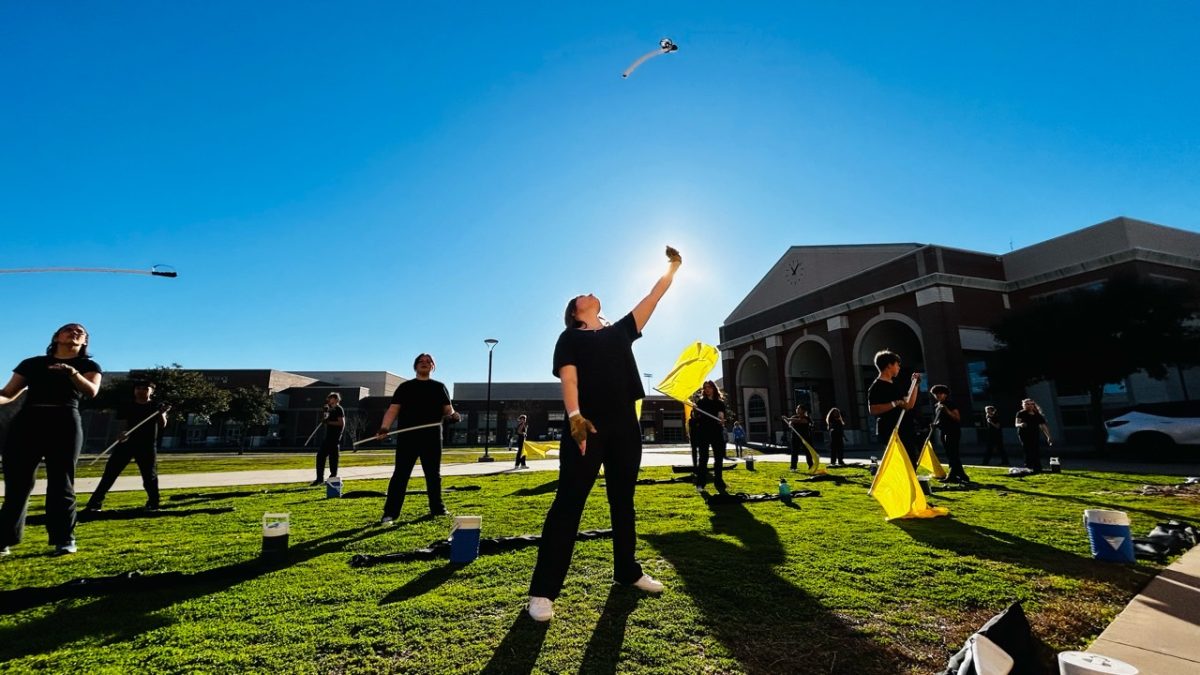

Every year, while most students savor the final weeks of summer, another group is already hard at work under the July sun: the high school marching band. From early-morning drills to late-season November performances, these musicians spend months perfecting a show that will captivate stadium crowds and impress judges on the competition field. Far more than halftime entertainment, marching band has become a demanding, high-energy activity where precision, teamwork, and school pride come together in every performance.
The Spirit of Joshua, SOJ, is celebrating a standout 2025 season marked by dedication, creativity, and unmistakable growth. This year’s production, Northern Lights, transports audiences into the shimmering world of the aurora borealis—a show designed to capture the ambient beauty and ethereal motion of the natural phenomenon.
“My freshman year, we had a show, we had UDB, [and we had alright] visuals. Not too great. Then, sophomore year, we had a vision. We tried. We did better than my freshman year, but we didn’t do as well as our potential,” junior clarinet Austin Rees said. “Finally, this year. We had a big vision for what we wanted to do. We went for it. We had a very cohesive show, and it worked really well regardless of results. We have improved leaps and bounds each year and that only leaves me wondering what is in store for the future?”
As the program has strengthened, leadership roles within the band have also taken on greater significance. Student leaders often find themselves navigating the balance between musical excellence, teamwork, and the unpredictable challenges that arise during long rehearsal days and competition season. Rees describes the weight of that responsibility, emphasizing how much behind-the-scenes effort goes into maintaining order and motivation over a hundred performers.
“As a leader in the band hierarchy, I serve to maintain order within the chaos that is the band. I try my best, and typically succeed, to keep the peace within interactions that I’m involved in. Band exemplifies controlled chaos, and I’m a small cog helping the process go smoother,” Rees said. “[Regarding skill], a lot of responsibility is put on me as the top chair. I am often expected to be the star example for anything and everything, which I don’t mind most of the time. It also leaves a lot of stress and anxiety in anticipating things like solos.”
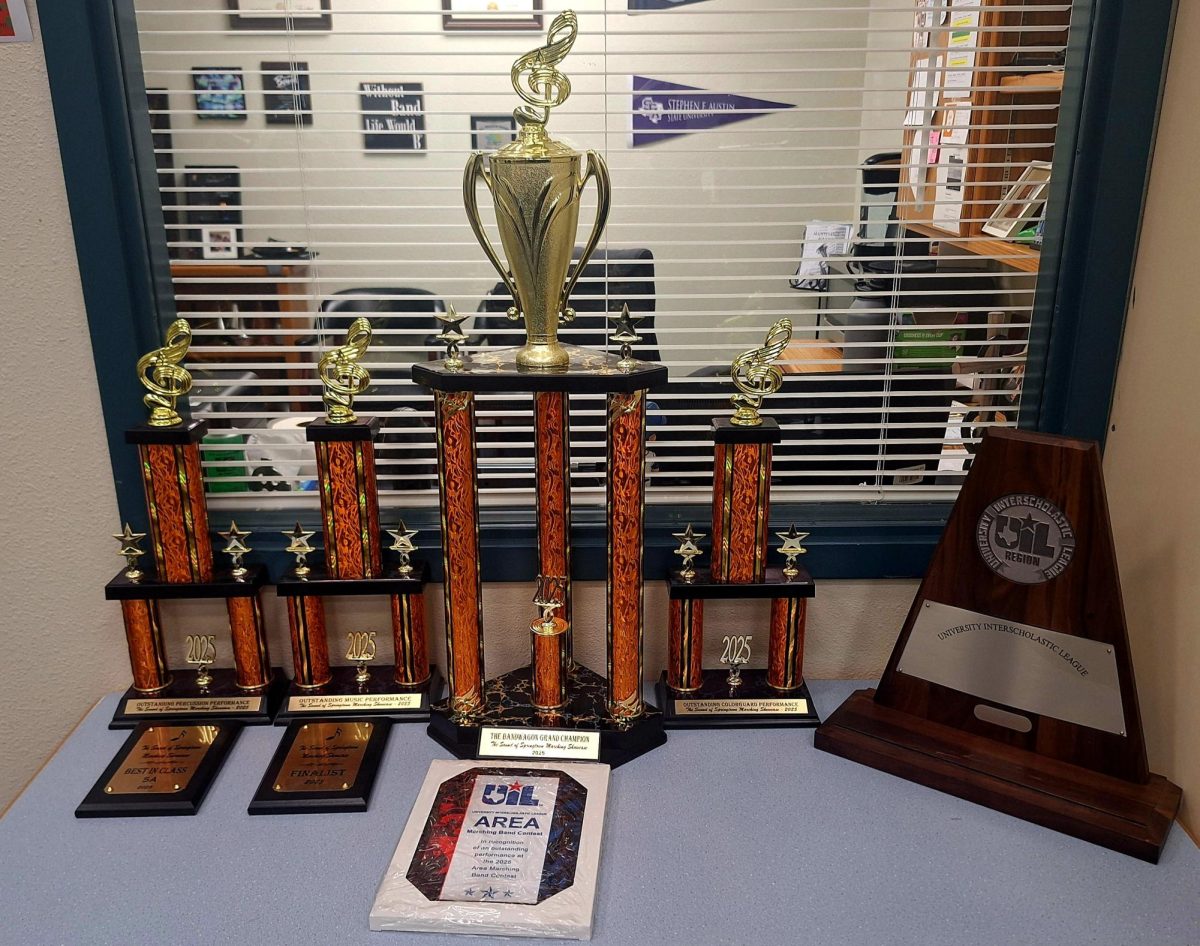
That pressure intensified as the season progressed and the SOJ set its sights on advancing deeper into the competitive circuit. The band’s efforts culminated in a strong performance at UIL Area, one that left members hopeful for a spot in finals—and devastated when they narrowly missed the cutoff. Even so, the experience became a moment of growth, teaching resilience in a way that scores alone cannot reflect.
“I thought we had a really good chance at making Area Finals [this year], like the directors say, one prelims round at a time,” Rees said. “It’s a bummer that we didn’t advance and it hurts even more that we barely missed it. However, I think wins and losses both develop us as people and as band members and so, no matter how it made me feel, I still learned, I still adapted, and I moved on.”
Still, despite the heartbreak, members recognize the tremendous improvement the SOJ has made over the years. From fundamentals to show quality, the band’s progress is visible not only to judges but to the students themselves, who have watched the program evolve from “mediocre” to competitive.
“In VERY recent years, I have seen the improvement of our band from really mediocre at some points to excellence,” Rees said. “We have come a long way and we have a long way to go, we are in a good spot, but there is always improvement to be made.”
A major part of that improvement comes from stronger visual design and better alignment between music and storytelling. Members emphasize that compared to previous years, Northern Lights showcased a more purposeful connection between theme, movement, and musical expression—something that elevated the entire show.
“Going back to how I compared visuals to previous years, we did more with visuals this year, and we made an effort to relate those visuals to the theme and music of the show more this year,” Rees said.
Even with such progress, band members acknowledge that marching band—unlike most school activities—exists within a heavily subjective competitive system. As students chase excellence, they also learn to navigate judges’ differing perspectives, knowing that the outcome of a season is never fully within their control.
“[Competition] in marching band is not the same as other sports due to the subjectivity when it comes to results. In games/sports like football, there are set rules, yes or no, score or no score. Strict numbers determined by a strict set of guidelines,” Rees said. “However, marching band is only competitive to the individual, and specifically to the judge. No judge is the same, no person is the same, no opinion is the same. Is marching band a sport? Yes, it requires skill, it requires competition. However, the method in which that competition is implemented is subjective rather than objective. There is no point gathering/scoring in marching band, it is all to the whim of a judges opinion.”
Through triumphs and disappointments, the SOJ’s 2025 marching season became more than a performance—it became a journey shaped by passion, discipline, and a shared belief in the power of continuous growth. And as the aurora-like visuals of Northern Lights fade into memory, the students behind the show carry forward the lessons, momentum, and pride that will guide the Spirit of Joshua into its next chapter.
“That is what makes marching band different from other sports, but that is also how the Fine Art aspect of band is implemented,” Rees said. “Art is subjective, and so too must be the competition of marching band.”